Sunday, April 22, 2007

Beijing is Picturesque

To my Western ear, the names of the city’s major attractions often sound hard to take seriously: the Forbidden City, the Temple of Heaven, the Gate of Heavenly Peace, the Hall of Supreme Harmony (not to be confused with the halls of Central Harmony and Preserving Harmony).

I mean, some of these classical superlatives you’d swear came straight out of National Lampoon, or some similar attempt to spoof Chinese culture. I am not making up the following labels on the various halls and sub-palaces that I passed during my wanderings around the Imperial Palace and the Summer Palace:

Literary Profundity

Beneficent Causation

Mental Cultivation

Eternal Safety

Tranquil Longevity

Reason Enhancement

Scrupulous Behavior

Proper Places and the Cultivation of Things

Earthly Tranquility

Heavenly Purity

Character Cultivation

Lasting Brilliance

Accumulated Refinement

Veranda for Rest Quiet

Eternal Peace

Endless Mists and Clouds

Chamber for Reading the Classics

Jade Islet in Spring Shade

Studio of Painted Boat

I saw no sign of plazas or monuments named after people. However, each sign did contain a modern twist. In small letters at the bottom were the words, “made possible by the American Express Company.”

Saturday, April 21, 2007

Beijing is Patriotic

Saying that this could be the Chinese century has become a cliché, but the people there did strike me as no nonsense and all business as they leap forward. I was impressed by the resolute expressions on even the uniformed workers along the roads who are paid to hold signs reminding drivers to slow down. They stared at me as though the success of China, Inc. depended on them.

Throughout most of my lifetime, it’s been true to say that the country’s best years happened long ago. Even now, the tour buses seem never to unload in front of anything built since the late 1700s. Foreign visitors seeing only those spectacular (though somehow also quaint) attractions might reasonably conclude that China hasn’t had much to brag about in the meantime.

But when those same foreigners stop to look at who else is getting off tour buses, they realize that their fellow sightseers are now likely to be from inside the country, and that these domestic vacationers are not only doing lots of bragging, they have money in their pockets to back it up.

Patriotic tour packages are apparently now all the rage. Wherever I strolled as a tourist, I was surrounded by large herds of Chinese. They were shepherded along by guides jabbering away on portable microphones, and carrying tall, uniquely-colored pennants, the better to keep their charges in line.

Tiananmen Square fills every morning and evening with proud Chinese wanting to see an honor guard raise and lower the national flag. The people walking beside me at the Summer Palace had their shoulders thrown back. I couldn’t help contrasting the feeling of purpose with the last few years’ news from the United States, with its stutter-stepping over Iraq, and its red-state-blue-state divisions.

There’s only one direction and one color in Beijing. For better or worse, the entire enterprise seems to know where it’s going.

Friday, April 20, 2007

Beijing is Determined

I had heard about dust storms coating Beijing with a thin layer of yellow grime. People had told me that Chinese often spit on the sidewalk. As our plane landed, my British seatmate pointed out the window at the grey morning and said, “See, the pollution here makes you think you’re walking around in a black-and-white film.”

Yet the stories all turned out to be wrong. Or at least they weren’t true this past week. It was a fine time to visit China.

The sun warmed and brightened everything—by mid-afternoon, I was peeling off my sweater. The tourist spots, anticipating next year’s Olympic Games, all seemed to have just been washed and painted. In the air were the smell of fresh cut grass and the “snow” from shedding poplars.

No matter where I went, in fact, trees were nearby. Greening campaigns have resulted in row after row of closely spaced trees, planted in part to reduce the effects of increasingly frequent sandstorms in the city. Seeing them on my way in from the airport was another reminder that the Chinese make no little plans. When they want to do something, they really do it. Big tree farms, grand boulevards, imperial palaces: everything is on a much grander scale than I’m used to.

It’s been that way for some time. While clambering along a lonely stretch of the great wall, I kept thinking about how remarkable it was that successive administrations continued to fund such a kooky project. They no doubt had many chances to say “OK, that’s good enough,” or “we don’t really need to protect that province,” but apparently they never did.

As we drove out of town toward our hike, the friend I was visiting remarked that the highway we were on had been completed only a few weeks earlier. After we turned off toward the hills, he noticed a few places where shortcuts had been built since the last time he had gone that way. At several intersections, he pointed out men standing next to large earth moving equipment. “Those guys and their machines are for hire,” he explained, as casually as if they were parked there selling ice cream.

A few hours later, returning to the freeway, we joked to each other, “Was this road here this morning?”

Saturday, February 24, 2007

Koh Si Chang is a Lotus

Platforms for natural gas exploration dot the Gulf of Thailand along the eastern seaboard. Enormous tankers anchor offshore, making for vistas that resemble Texas more than Thailand. It has become an awkward place to put an island.

But Koh Si Chang makes for a lovely daytrip or overnight, despite the busy industrial harbor it helps shelter. The hour’s ferry ride snakes through freighters flying flags from around the world. On arriving, passengers step onto a pier lined with markets (all those superships have to get their fresh vegetables and beer from somewhere). Up the hill, a Chinese temple looms. There’s not a beach in sight.

I visited on a weekday at the tail end of Chinese New Year. The temple seemed a timely place to begin a tour. Volunteers at the top of the serpent staircase offered me several opportunities to accumulate merit and good luck in the coming year. My small donations also earned me various scrolls and the reading of my name over a loudspeaker.

Having gotten my future sorted out, I settled into appreciating the present. The seaward side of the island was much emptier than the side with the ferry landing. I had the place to myself, aside from a young couple in full wedding gear who were taking pictures with a handsome boardwalk and the beautiful open ocean as a backdrop. I spent nearly an hour prowling the headland.

Such views were apparently what drew a few generations of Thai kings to the island, back in the 1800s when they would sail down the river from Bangkok, and then out into the gulf. Today, their former palace grounds make for nice strolling. They include a hillside stupa where King Rama V liked to meditate. It’s still a good place to contemplate life, for being beach-free also means that the island is jet-ski-free.

In fact, as I ferried back to real life at the end of a long travel day, my attitude was so altered that I took no notice of the floating factories on either side of the boat. Koh Si Chang is like the lotus flower that blossoms out of the mud, rising above defilement and suffering.

Wednesday, January 3, 2007

Lopburi is Lucky

They say a little knowledge is a dangerous thing. But that adage doesn’t always apply to travel.

Mostly because I didn’t really know where I was heading, I ended up spending a dandy day at Wat Khao Wong Phrachan in Lopburi province. I never would have never found (or even attempted) the place had I brought a guidebook along.

Most people go to Lopburi, about three hours north of Bangkok by train, to see the monkeys. The Khmer-style ruins in the center of town are crawling with the tame little critters. Before I left home, I glanced at a Lopburi website, which briefly listed a temple about 25 kilometers from the city, “surrounded by shady trees and beautiful views of nature,” near the province’s highest mountain.

What the site didn’t say was that “near” the mountain really means “at the top of a flight of about 3,000 steps.” Even after hopping off a local bus and riding the final few kilometers by motorcycle taxi, I still didn’t realize that visiting the temple would involve any climbing. At right is the view looking back from the halfway mark.

Luckily some entrepreneurs sell water along the way. The mountain was one of those whose summit looks closer than it really is. See for yourself: can you spot the temple up top in this picture? Happily, the 360-degree view, and the pleasant breeze, was a fine reward for the sweat required to reach the highest point.

And when I finally got back to the main road, it turned out that my motorcycle man doubled as a seller of banana fritters, making the unplanned day that much sweeter.

Monday, December 11, 2006

Cambodia is Ruined, But Not Wrecked

Visiting ruins can get old fast. After the initial thrill and put-yourself-in-their-shoes imagining wears off, I find sometimes that each new site begins to look like the last.

Not so at Angkor Wat. We spent three transfixing days of total-immersion temple hopping. I was ready to return there on the day after we left. I can hardly wait for my next visit.

It’s not just the grand scale of this ancient city that impresses. At nearly every stop, we were stunned and re-stunned by the massive stones and the symmetry and the echoes of a great civilization.

The other thing that kept running though my mind was how, over eight or so centuries, countless forces have conspired to destroy the place—from armies to jungles to weather to tourism to poverty to younameit.

Yet despite its struggles, Angkor Wat is far from wrecked. You can’t wreck it.

Some people might be able to go there and not visualize it in its heyday, when no metropolis on earth could match it. It was as big as Rome.

Or maybe you could lessen the magic by rushing things, trying to squeeze the whole complex into one or two hot days, rather than seeing a little bit at a time, at different times of day. Even if you did go too fast, though, I doubt you could wreck it.

I was moved by the way Cambodia seems to have resisted the temptation to, say, build a high-rise hotel across the moat from the central attraction. Likewise, it would have been easy enough to justify a banner over the entrance to the Bayon, announcing that the reconstruction had been made possible by a generous grant from, say, Citibank.

So far the country has made more right choices than wrong ones. The town of Siem Riep has been allowed to become tacky, but that’s several miles away. Kids are permitted to hawk postcards outside the entrances to certain sites, but once we were inside they never approached us. Lots of treasures have been looted or vandalized, and yet Angkor Wat still dazzles. Even the temples that have crumbled and been left that way are charming. I doubt I could get tired of it.

Cambodia is Bumpy

After glimpsing the country briefly from Preah Vihear, we re-entered Cambodia at the Aranyaprathet – Poipet border crossing. My dad remarked that the experience reminded him of an old New Yorker cartoon in which a thunderstorm stops at a state line in the Western U.S.

Road quality changed abruptly between Thailand and Cambodia. Here’s an image, borrowed from a BBC webpage, of the highway we traveled. Five hours of vibrations and dust and close overtaking nearly did us in. Luckily, there wasn’t much traffic—nearly as many oxcarts as engine-powered vehicles.

Until we reached Siem Reap, that is. The home of Angkor Wat might as well have been another country. Brand new pavement instead of potholes. A gleaming hotel every few hundred yards. We didn’t so much notice the fall of darkness as we did the rise of neon.

If we had flown in and flown out of the country, we couldn’t have said we had been to Cambodia. But I’m also glad we didn’t have to return to Thailand by car.

Sunday, December 10, 2006

Cambodia is Vacant

My parents flew across the Pacific to see us. We planned an excursion to Cambodia. Their first view of it was from the edge of a tall cliff. This vantage point, called Preah Vihear (Khao Prah Viharn in Thai), has a profile similar to a sinking ocean liner. The bow points skyward at a fairly sharp angle. At the tip is an ancient temple.

The Thai-Cambodian border at that point is effectively formed by the rim of this escarpment. An international court awarded the disputed temple site to Cambodia some years back, so technically we were already in the country as we climbed the steep steps from the Thai side up to the ruins.

The monument itself, relative to others in the area, is nothing too special. But the effort to reach it was more than rewarded by the view of a wide plain that revealed itself when we were just one step away from the cliff edge. If we didn’t know better, we’d have said the country looked as peaceful as the sea on a windless day.

Alas, the nearly roadless expanse in front of us appeared empty and serene partly because it’s chock full of landmines. Few people choose to live in that part of Cambodia, for fear of losing a limb. Development there proceeds only as quickly as the demining efforts, which is to say not very quickly.

Sunday, November 19, 2006

Samut Songkhram is Sparkling

The first time I went to Samut Songkhram, I went by bus with my friend Joy. We planned to return by train, and so we dropped by the station to ask about the last departure of the day. The station master said, “I’m not telling.”

“Excuse me?” Clearly we had a translation problem. But he repeated himself. He really didn’t want us to leave town. Acting more as a self-appointed chamber of commerce than as a hustler, he proceeded to explain this was the time of year when a local species of firefly puts on a fantastic nightly show.

He recommended that we book rooms at one of the many canal-side “home stays” (bed and breakfasts), and hire a boatman to take us around after dark for a tour of the famous glittering insects. It didn’t happen that night—Joy and I both had reasons to get back to the city—but when someone at work asked if I wanted to join a group that was planning a visit to the fireflies, I remembered the station master’s advice and said yes.

These hing hoi, as they’re known in Thai, are not your American fireflies. They all hang out in trees, blinking in unison, as if they were Christmas lights. As our boat motored along the river, I remarked to my friends that perhaps the difference was due to cultural training—Americans being taught to value individualism, Thais preferring not to upset the social order.

They naturally treated my comments with the respect they deserved (zero). At dinner, I gave them another reason to roll their eyes. We had stopped at a nice riverside restaurant, where we ordered fish. When it looked to me as if we had picked clean the top half of the fish, I reached out to turn it over, as I had seen many Thai people do at restaurants.

Screams went up. Hands waved. Somebody patiently took me aside and enlightened me. When traveling by boat, I was told, it’s bad luck to flip a fish, for fear the same thing will happen to your vessel later. I believe this is a lesson that will stick. It has now been several days and I have not repeated the error.

Thursday, November 16, 2006

Nakhonchaisri is Larger than Life

Wax museums are supposed to feel authentic, but the one we stopped at in Nakhonchaisri, a small city near Bangkok, goes beyond that. I actually asked directions of one of the figures. She didn’t look up from the paperwork that she is perpetually doing near the entrance.

“Wax” isn’t formally part of the museum’s name, because the creators have found that fiberglass does better in this climate. Another difference between the Thai Human Imagery Museum and the kind I’m used to from the States is the type of person portrayed there. On the first floor, 90% of the figures were monks. The Thais I accompanied knew every one of them.

It isn’t until reaching the second floor that a musician or a person from pop culture appears. Some of the figures are of people who never truly lived, but are as well known as if they had. Occupying a prime corner, for instance, are characters from a beloved Thai epic, Phra Abhaimani. This is another love triangle tale, complete with princes, princesses, demons, a giant, a hermit, and a half dragon half horse.

Phra Abhaimani is a younger story than Khun Chang Khun Phaen. It is attributed to one writer, Sunthorn Phu, rather than to the oral tradition. I was surprised to learn that some of the characters in it are foreigners. Sunthorn Phu was evidently commenting on how well Thais and Westerners get along. The story is taught in schools throughout Thailand, and so, as with the monks, my fellow travelers could identify all of the figures by name.

Sunday, October 15, 2006

Suphanburi is Epic

When I’m on the road I like buying the newspaper for some local color—the more local, the more colorful. Thailand offers no shortage of rag sheets, tabloids, and tales of romance or true crime. My reading vocabulary, though, still has a ways to go before all that mystery and drama is accessible to me.

Instead I settle for the epics, stories that have been handed down for long enough that they’ve attracted the attention of a translator. Generally they contain material that’s not so different from the tabloids—it’s just older and thus that much more respectable. The light covering of dust on these epics obscures their naughty bits.

A story called Khun Chang Khun Phaen came my way. It interested me enough that I traced it to its source. Suphanburi is a province not far out of Bangkok, an easy day trip. Its other claim to fame, as far as I could gather, is a space needle-like thing in the center of the provincial capital, built when a favorite-son prime minister was in power, as a sort of monument to himself. On the outskirts of town sits a temple that has weathered several centuries since it was the center of the epic in question.

It was here that a novice monk called Phaen first laid eyes on a beautiful maiden named Wanthong who had come to the temple with offerings of one kind or another. Strictly speaking, if he’d been any kind of monk at all, he’d have kept his eyes lowered. But of course if he had, we wouldn’t have much of an epic.

We’re also told early on that Phaen wasn’t the only one interested in this young beauty. The rival, a layman, had also shown up at the temple on a dual errand. Partly he hoped to make merit, like Wanthong did, but mostly he wanted to show off his wealth yet again (as if the town needed to be reminded), this time in hopes that it would win the hand of Wanthong.

So with that love triangle set up in Chapter 1, we know we’re in for several nights of, say, romance and true crime.

What catches the Westerner off guard is just how bawdy the romance can get. Over the course of the tale we also learn a good deal about Buddhism, Thai geography, supernatural beliefs, and the complex role of women in Thailand.

It’s nice to study this tale on site because recently the temple has commissioned a series of gorgeous painted scenes. The nearly two dozen intricate renditions contain enough detail so that viewers will always find something from the many-chaptered story that they haven’t seen before, even after multiple visits. I spent about two hours. Despite some helpful bilingual captions, I just scratched the surface. No doubt I’ll be back.

Monday, June 12, 2006

Laos Isn’t Thailand

Despite a similar language, similar food, and a similar history, Laos reminded us every day that it wasn’t the country we’d come from. No traffic! No cell phones (well, hardly any)! No convenience stores!


I especially liked the small differences in the temple styles. In the north we saw mosaics on the temples walls that reminded me of primitive folk art. Roofs sprouted the classic little horns at the corners, like in Thailand, but sometimes also featured a kind of cock’s comb at the very top.


After dinner one night a few of us decided to check out the night life. We weren’t sure what we’d find, but we were pretty certain it wouldn’t be a trendy club or a rooftop bar of the kind on offer in Bangkok. Our young, hip Lao guide recommended a spot she said was the hottest in town. In fact she had brought along a special outfit, hoping to go there herself.

At the door we were frisked. Once inside, it took us a few minutes to adjust to the gloom. Suddenly the mirrored ball started turning, and the spotlights focused in on a row of elderly gentlemen in white shirts, slinging electric guitars. Louis Louis! Staying Alive! Light my Fire!

Surrounded by more funk and disco than I’ve heard since my last high school dance, we partied hardy till at least … 9:30, when it seemed like maybe the musicians were starting to think about their bedtimes.


Laos is Quaint


When we toured the former royal palace, I expected everything to feel royal. That is, I thought we’d see high ceilings and fancy curtains and staid-looking portraits in gilded frames.

Which we did. The place had a European feel—no surprise, considering that much of it was designed and built by the French.

On leaving, though, I noticed a little touch that threw me off. Everything else we saw had at least belonged in that setting, even though occasional shabbiness hinted that it had been some time since Laos had had either the means, or the motivation, to glorify its rulers. But the mat on the threshold of the main entry just didn’t fit. One doesn’t normally find such accessories in SE Asia in the first place, but especially not ones featuring four cute little doggie faces, and the English word, “Welcome” in one corner.

Laos is Quiet


At the temple on top of Pousi Hill in the center of Luang Prabang, a large crowd had gathered by our standards. For most of this first day in the country, we had had the wats to ourselves. Yet in spite of the mob, conversations were hushed, almost mumbled, as the sun set spectacularly behind the peaks on the opposite side of the Mekong River.

A steady breeze ruffled the trees as we followed the sun and headed down. Dusk had fallen by the time we reached the gate. The town felt as if it were yawning all at once.

I expected that when we stepped into the street, we would find empty sidewalks, and restaurants that had already finished serving. But instead we turned onto a sort of parade route, a narrow walkway lined with vendors of all ages and descriptions, mostly sitting on mats on the ground, surrounded by their wares, silently waiting next to a candle or a bare battery-powered light bulb.

It was off season, so the town wasn’t packed with visitors. Also, the early evening hour meant that peak shopping hours were still to come. Still, it seemed to me that there wasn’t an empty slot anywhere along the sidewalk or along the middle of the street to squeeze another salesperson. They were all entirely set up, their goods arranged in colorful, attractive patterns.

As we walked among them, I had the sense of being treated almost like visiting royalty, stepping slowly down a sort of red carpet of commerce. The most anyone said to us was, “Sabaidee.” The sounds I associate with markets in Thailand—boomboxes bumping, hawkers calling out “Good evening, sir,” TVs on in the background—were all absent.

Perpendicular to the market street, with its sarongs, t-shirts, hilltribe dolls, cotton pants, shoulder bags, wall hangings, and whatnot, was an alley. Its noises were a bit more familiar—lots of giggling and shouting among salespeople. Yet along the main drag, the merchants might just as easily have been worshiping or waiting to offer alms to monks. (Less than twelve hours later, we did just that along that same strip, surrounded by the same surreal silence). I wouldn’t have been surprised had some of the vendors suddenly prostrated themselves as we walked past.

Just to add to the general dreamlike quality of the scene, when we reached the end of the night market, and were waiting for everyone to be accounted for, I looked up at a handsome balcony attached to a colonial-era building. The sun had long since set, and the view from that balcony didn’t face anything especially scenic, so at first I was surprised to see three Westerners up there, apparently gesturing wildly toward some object in the distance. The longer I watched them, the more I could see that their gestures were really ritual bows, performed regularly and quickly, in time with a beat that I couldn’t hear. Then I figured it out—it was Friday night, the hour for the observant Jews of Luang Prabang to say “shabat shalom.”

Sunday, June 11, 2006

Laos Through Thai Eyes

For a foreigner with no goals, surrounded by Thai friends, a recent package tour to Laos felt like the perfect trip: perfect pace, perfect itinerary, perfect price.

I’ve held off writing about it, maybe because I was afraid the magic might disappear if I put it down on paper. Our whirlwind tour, during a long weekend in May, took us from Vientiane to Luang Prabang and back again, via plane, boat, and minivan. The group included ten Thai work colleagues, a Lao guide, a Lao driver, and me.

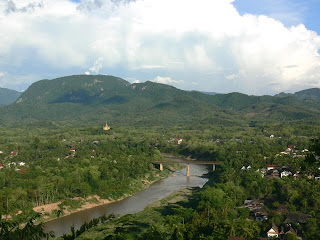
Tourism Thai-style involves lots of photo opportunities. When we got back to the office and pooled all of our digital pictures, we had enough to nearly fill two CDs. Here are a few of the best (click them to enlarge them), along with some impressions film can’t capture.